
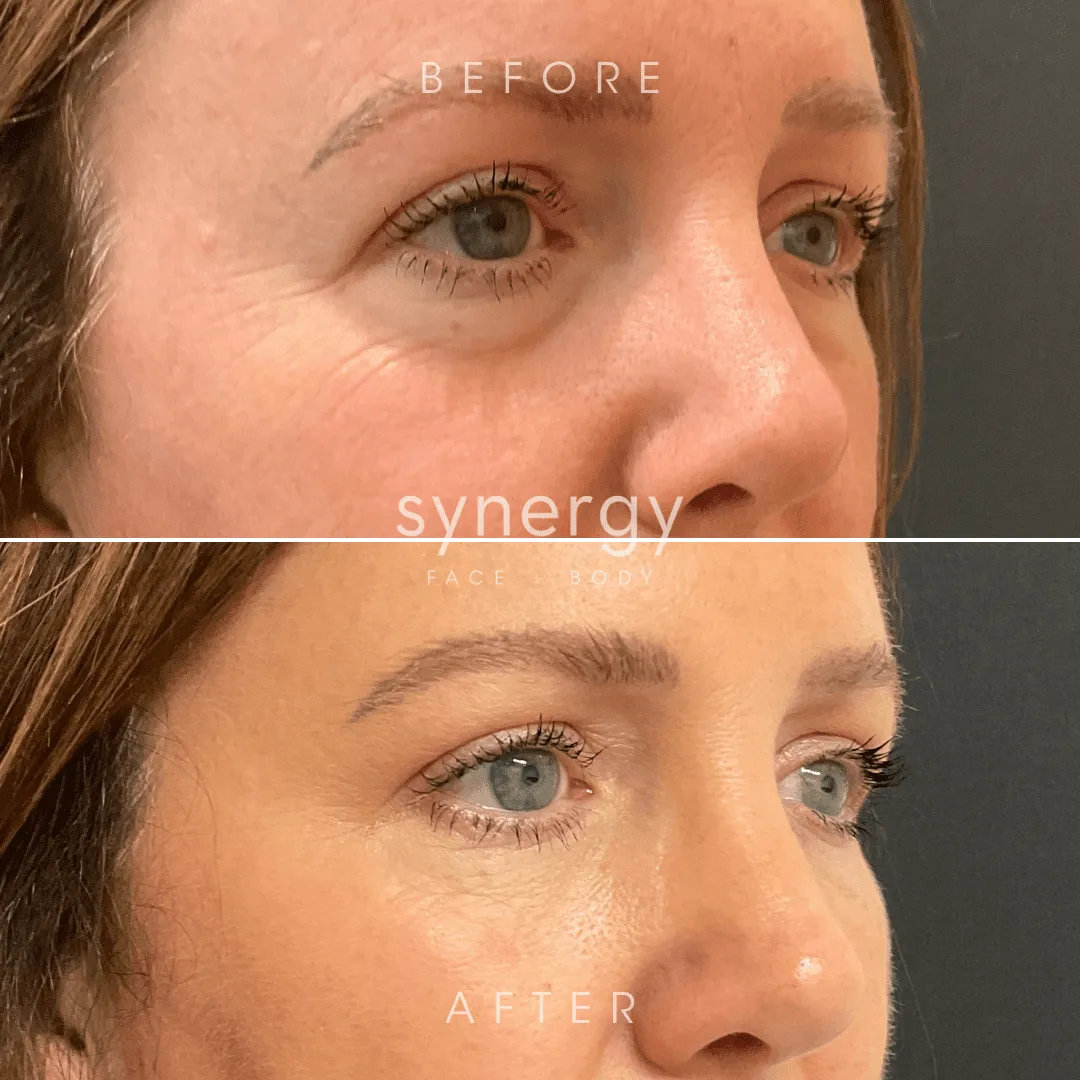
Restylane is a family of FDA-approved hyaluronic acid dermal fillers used to restore lost facial volume, smooth wrinkles and folds, and enhance features like the lips, cheeks, and under-eyes. Unlike treatments that build results over weeks, Restylane works right away. You leave the office looking different than when you came in. Depending on the product and the area treated, those results typically hold for six to eighteen months. At Synergy Face + Body, we use Restylane regularly across a broad range of patients at our Richmond and Midlothian offices, choosing specific formulations based on each person’s anatomy, concerns, and goals.
Key Takeways
- Restylane is a hyaluronic acid dermal filler that restores lost volume, smooths wrinkles, and enhances features like the lips, cheeks, and under-eyes.
- It works by drawing moisture into treated areas, helping skin look fuller, smoother, and more elastic while delivering a temporary but long-lasting lifting effect.
- Different Restylane formulas are tailored to specific concerns, from facial folds and under-eye hollows to cheek contouring and lip enhancement.
- Results are visible right away and can last about 6 to 18 months, depending on the product used, treatment area, and how your body metabolizes the filler.
What Is Restylane?
Restylane is a brand of injectable hyaluronic acid filler manufactured by Galderma. To understand what Restylane does, it helps to understand what hyaluronic acid is and what happens to it over time.
Your skin contains hyaluronic acid naturally. It’s a sugar molecule that acts like a sponge, attracting water and keeping tissue plump, hydrated, and elastic. It’s a big part of why young skin looks and feels the way it does. As we age, the body produces progressively less of it. Skin loses volume, tissue migrates downward, and wrinkles deepen.
Restylane works by replacing what’s been lost. It contains a stabilized, cross-linked form of hyaluronic acid that behaves similarly to the body’s own version. Because your body already produces hyaluronic acid, Restylane integrates well into tissue and carries a low risk of allergic reaction.
One more thing worth knowing: Restylane was the first FDA-approved hyaluronic acid filler in the United States. It has a longer safety record than most competing brands.

The Restylane Product Family
Restylane is not a single product. It’s a family of formulations, each designed for a specific job. The differences between them come down to particle size, cross-linking density, and how stiff or flexible the gel is, which determines where each one performs best in tissue.
Here’s a breakdown of the major formulations and what they’re used for:
- Restylane and Restylane-L: For mid-to-deep injection to correct moderate-to-severe facial wrinkles and folds, including nasolabial folds. Restylane-L contains lidocaine for added comfort.
- Restylane Lyft: A firmer, higher-lift product for cheek augmentation and midface volume. Also FDA-approved for hand rejuvenation.
- Restylane Silk: A fine-particle formula for lip augmentation and smoothing the vertical lines around the mouth.
- Restylane Kysse: An FDA-approved lip filler with flexible cross-linking that allows the lips to move naturally while adding volume and definition.
- Restylane Refyne and Defyne: Both treat nasolabial folds and marionette lines using XpresHAn Technology, which keeps movement looking natural. Defyne handles deeper folds; Refyne is suited to more moderate lines.
- Restylane Contour: For cheek augmentation and midface contouring, with flexibility that supports natural expression.
- Restylane Eyelight: An FDA-approved under-eye filler using a NASHA-based gel to fill tear trough hollows and reduce shadowing. Approved for adults over 21.
Picking the right formulation matters more than most patients realize. A product that’s too stiff in a delicate area, or too soft where you need structural lift, produces poor results and breaks down faster. During your consultation at Synergy Face + Body, we walk you through which products we’re recommending and the reason behind each choice.
How Does Restylane Work?
Yes! And the mechanism is simpler than most people expect.
Once injected, Restylane physically fills space beneath the skin’s surface. It pushes outward against depressed areas, lifts the surrounding tissue, and draws water to the site, adding hydration that contributes to the overall effect. Results are visible immediately because this is a physical correction, not a biological one. Volume goes in, and the tissue responds right away. There’s no waiting for your body to activate a healing response or build new cells.
Over time, the body’s natural enzymes gradually break down the hyaluronic acid chains, and the filler is slowly absorbed. The breakdown is gradual enough to maintain results for months, and complete enough that you return to your natural baseline if you stop treatment. That predictable fade is one of the real advantages of hyaluronic acid fillers: if you change your mind or want something adjusted, there’s a path back.
Something patients often don’t anticipate: the hydration Restylane brings to the treated area tends to improve the overlying skin, not just its volume. Texture and elasticity often look better, too. It’s the combination of structural support and deep hydration working together, addressing surface-level aging alongside the volume loss underneath.

What Is Restylane Used For?
Depending on the formulation, Restylane addresses a broad range of concerns across the face and hands.
Wrinkles and folds: Nasolabial folds and marionette lines are the most commonly treated areas. Restylane, Restylane-L, Refyne, and Defyne are each suited to these depending on fold depth and how much flexibility of movement matters.
Lips: Volume, definition, and perioral lines all respond well. Silk and Kysse are the two formulations I use most often for lip augmentation at Synergy Face + Body, and both carry FDA approval for this use.
Cheeks and midface: Lyft and Contour restore cheek volume and lift the midface, addressing the flattening and downward tissue migration that accelerates after 40.
Under-eyes: Eyelight treats the tear trough hollows that create the shadowed, hollowed look under the eyes. Topical products rarely make a meaningful difference here. Filler often does.
Hands: Restylane Lyft is FDA-approved for the backs of the hands, where volume loss causes veins and tendons to become progressively more visible with age.
How Long Does Restylane Last?
The honest answer is six to eighteen months, and that range is real. Here is what actually drives it.
Product and area: High-movement areas break down filler faster. Lip filler generally lasts six to twelve months. Cheek and midface products like Lyft and Contour tend to hold for twelve to eighteen months. Eyelight in the tear trough can last up to eighteen months with optimal treatment.
Individual metabolism: Some people consistently metabolize filler faster than others, and it has nothing to do with how healthy or fit they are. It’s just how their body handles it. Patients who know they break down filler quickly should plan for touch-ups closer to the six-month mark.
Injection depth: Filler placed deeper in the tissue lasts longer, because it faces less mechanical disruption than filler placed closer to the surface.
Maintenance timing: In my practice, most patients come back between nine and twelve months after their initial treatment. I usually recommend scheduling a touch-up when you notice about twenty to thirty percent loss of effect, rather than waiting until results are fully gone. Maintaining some residual filler in place tends to extend longevity over time and typically requires less product at each visit.
Is Restylane Safe?
Restylane is FDA-approved and has more than twenty years of clinical safety data behind it. When treatment is performed by a qualified injector with a strong command of facial anatomy, serious complications are rare.
Common side effects include swelling, redness, tenderness, and bruising at the injection site. These are temporary and typically resolve within a few days to two weeks, with swelling most pronounced in the first twenty-four to forty-eight hours.
Serious complications are uncommon, but they are real. Any provider who glosses over them is not doing you a service. Vascular occlusion, where filler enters or compresses a blood vessel, is the most significant risk and requires immediate treatment. Nodule formation, infection, and asymmetry can also occur, and most are manageable when caught early.
As a double board-certified facial plastic surgeon, my understanding of facial anatomy goes well beyond injection technique. I know which structures to avoid, what warning signs to watch for, and how to respond if something goes wrong. At Synergy Face + Body, I perform all filler injections personally and cover these risks honestly during every consultation.
Can Restylane Be Dissolved?
Yes. One of the genuine advantages of hyaluronic acid fillers over other injectables is reversibility. Restylane can be dissolved with hyaluronidase, an enzyme that breaks down hyaluronic acid quickly and predictably.
Dissolving is used in two situations. The first is urgent: a suspected vascular occlusion, where fast dissolution can prevent serious tissue damage. The second is elective: a patient is unhappy with their result and wants to return to baseline. In non-urgent cases, most filler breaks down within several days of treatment.
Some swelling for one to two days afterward is normal. Some patients choose to refill the area differently at a follow-up appointment; others prefer to wait and see how their natural tissue looks before deciding whether to retreat.
What to Expect Before, During, and After Restylane Treatment
A Restylane appointment at Synergy Face + Body starts with a consultation. I assess your facial anatomy, listen to what you are hoping to achieve, and walk you through exactly which products I am recommending and where I plan to place them. If you have had filler elsewhere, I also evaluate any existing product before adding more. Layering filler without accounting for what is already there can create problems, and this step is not optional.
The injection itself takes thirty to sixty minutes depending on how many areas we are treating. Most Restylane products contain lidocaine, which significantly reduces discomfort. Topical anesthetic can be applied beforehand for more sensitive areas.
After treatment, expect some swelling and possibly bruising, most noticeable in the first twenty-four to forty-eight hours. In the lips, swelling peaks in the first one to two days and resolves substantially by days five to seven. The final shape becomes clear at two weeks.
For the first twenty-four to forty-eight hours, avoid strenuous exercise, saunas, and anything that significantly raises your heart rate or body temperature. These increase blood flow and can worsen swelling, bruising, and may affect how the filler settles. Makeup should be avoided on injection sites for twelve to twenty-four hours.
Results are visible right away, but the final outcome is best assessed at two weeks. Most patients find the two-week mark reassuring, even when early results already look good.
Schedule a Restylane Consultation in Richmond or Midlothian
If you are considering Restylane and want to know which formulation makes sense for your goals, I am happy to talk through it. At Synergy Face + Body by Travis Shaw, I perform all filler injections personally and take time in the consultation to explain what I am recommending and why. To schedule at our Richmond or Midlothian office, call 804-406-3364 or contact us online.
